
www.automation-mag.com
03
'26
Written on Modified on
Industrial Control Room Decision Support Software for Process Anomaly Detection
ABB launched the ABB Ability Augmented Operator suite to mitigate control room workforce shortages and assist real-time decision-making.
global.abb
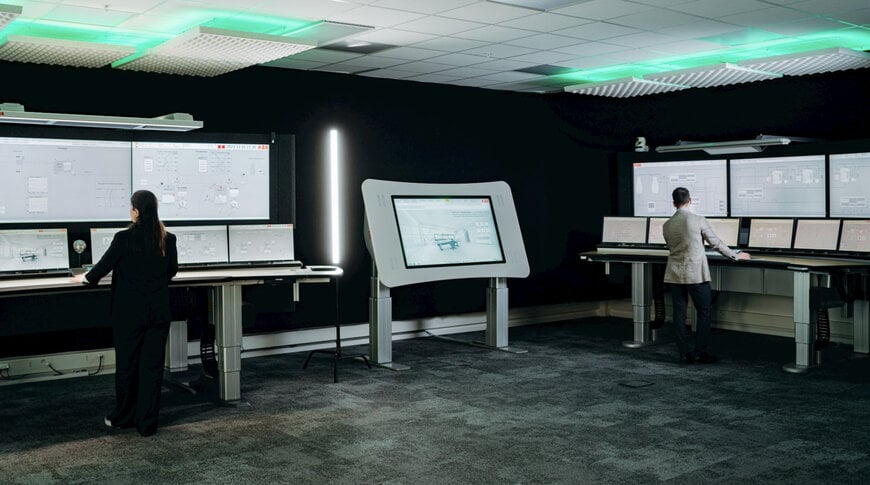
Process plants face widening knowledge deficits as experienced engineers retire, leaving leaner control room teams to manage increasingly automated and complex facilities. Addressing these operational and demographic strains, ABB introduced the ABB Ability Augmented Operator software suite, an artificial intelligence system engineered to help control room personnel detect process anomalies, retrieve historical operational responses, and simulate intervention outcomes prior to execution.
Operational Context and Decision-Support Architecture
Continuous process facilities across chemical manufacturing, hydrocarbon processing, thermal power generation, and municipal water treatment require round-the-clock supervisory control. When unexpected process drifts occur, operators must parse thousands of concurrent telemetry signals, process variables, and alarm states. An incorrect setpoint adjustment or delayed intervention can lead to off-specification batches, thermal runaways, flaring events, or unplanned emergency shutdowns.
Compounding this operational pressure is a widening demographic imbalance across technical vocations. According to data from the International Energy Agency, advanced economies record 2.4 energy sector workers approaching retirement age for every new entrant under 25 years old. As facilities consolidate management into centralized remote operation centers, smaller teams oversee larger operational envelopes, increasing reliance on empirical plant knowledge that historical personnel often took with them upon retirement.
Integrated Anomaly Detection and Predictive Simulation Mechanism
ABB Ability Augmented Operator integrates directly into distributed control system operator workstations, functioning as a real-time advisory layer rather than an opaque autonomous controller. The software architecture monitors multivariate process data streams simultaneously, identifying low-amplitude deviations and cross-variable correlations that precede conventional high-low threshold alarms.
The system workflow consists of three primary engineering mechanisms operating within a unified graphical interface:
- Multivariate Anomaly Identification: Machine learning algorithms analyze live sensor data against baseline operational models to isolate subtle operational deviations before hard process limits or safety instrumented trips activate.
- Historical Context Retrieval: When an irregularity is detected, the engine queries the facility historical process archive, indexing prior occurrences that exhibited similar multivariate signatures. The software displays the root causes identified in those past incidents along with the specific corrective actions taken by previous engineering shifts.
- Predictive What-If Simulation: Prior to committing manual adjustments to control loops, operators can run localized predictive simulations. The software projects critical process variable trajectories over forward time horizons, displaying the probable consequences of a planned change and verifying that safety envelopes will not be violated.
Throughout this process, the software provides explainable recommendations based on empirical operational records, ensuring that final execution authority remains strictly with the human operator.
"AI will play a growing part in the control rooms of industrial facilities, but it has to earn its place there. Operators need to understand and trust the tools they rely on, so how AI is introduced matters as much as what it can do," stated Gino Hernandez, Head of Global Digital Business at the Energy Industries division of ABB. "ABB has designed Augmented Operator to explain its reasoning, draw on a facility own experience and let operators test a change before they make it. This offering is an important step toward more autonomous operations, while keeping the humans in the loop."
Trade show and Operational Impact
The software suite was presented during the ADIPEC 2026 exhibition and conference, held from 2 to 5 November 2026 at the Abu Dhabi National Exhibition Centre in Abu Dhabi, United Arab Emirates.
Within continuous processing units, early anomaly mitigation stabilizes operating envelopes, narrows shift-to-shift performance variance, and reduces off-specification production volume. By systematizing institutional operating experience into an accessible advisory system, industrial operators standardize response protocols across multi-plant portfolios and accelerate the onboarding of early-career control room engineers.
Additional Context:
This section details technical specifications and competitive benchmarking not included in the original product announcement.
Industrial control room advisory systems operate at Level 3 and Level 4 of the ISA-95 enterprise-control integration model, bridging real-time Distributed Control Systems (DCS) with manufacturing operations management software. Historically, alarm and situational awareness management relied on static engineering guidelines governed by standards such as ANSI/ISA-18.2 (Management of Alarm Systems for the Process Industries) and EEMUA Publication 191. While effective for rationalizing nuisance alarms, standard alarm systems remain fundamentally reactive, triggering notifications only after a measured variable transgresses a preconfigured threshold.
Decision-support platforms in the process automation sector include Honeywell Forge Connected Operations, which provides predictive analytics and performance benchmarking against plant digital twins, and Emerson DeltaV InSight and Plantweb digital ecosystems, which embed loop health monitoring and root-cause diagnostics within the automation architecture. Yokogawa Electric addresses similar operational workflows through its Dynamic Real-time Optimization and Modular Procedural Automation solutions based on ISA-106 standards, which automate operating sequences for non-routine tasks.
ABB Ability Augmented Operator differentiates its workflow architecture by unifying multivariate anomaly detection with automated historical log pattern matching and integrated operator-in-the-loop dynamic simulation. Rather than replacing existing Level 2 regulatory control loops or advanced process control matrices, the software functions as an overlay on systems such as ABB System 800xA and third-party control architectures. By leveraging industrial data connectivity via standard OPC UA interfaces and time-series historians, it converts multi-year process telemetry into explainable, non-generative operator guidance without requiring direct write-access to safety instrumented systems governed by IEC 61511.
Edited by Natania Lyngdoh, Induportals editor, with AI assistance.
www.abb.com
