
www.automation-mag.com
27
'26
Written on Modified on
ORAFOL Reduces Optical Inspection Times With Zebra Vision
Machine vision and deep learning automate the quality control of millions of Fresnel micro-lenses.
www.zebra.com
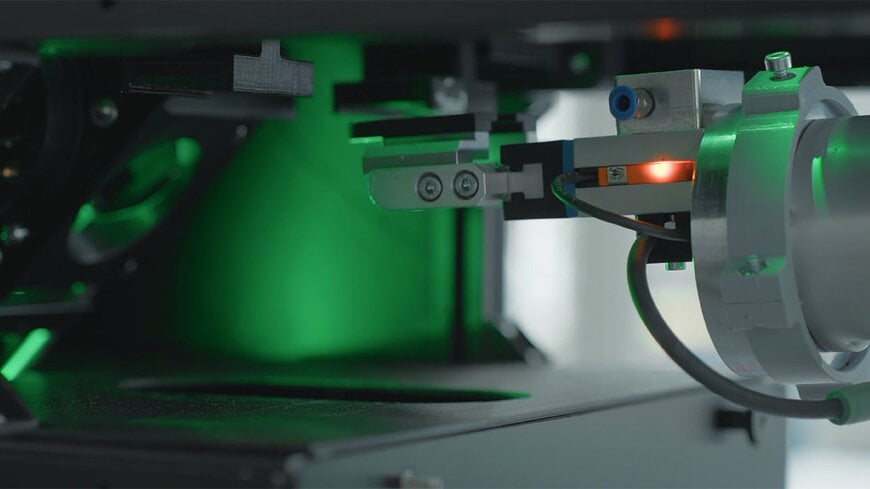
ORAFOL Fresnel Optics GmbH has halved the inspection time for its optical lenses by deploying an artificial intelligence-based machine vision solution from Zebra Technologies. Faced with the complexity of manually checking plastic components sometimes as small as 4 mm in diameter, the German company automated the process to guarantee continuous 24/7 operations and ensure end-to-end traceability for over 1.5 million lenses already inspected.
Automating Complex Quality Control
Before this integration, inspecting the microstructures of Fresnel lenses required 15 operators to examine each part under specific lighting. To overcome the visual fatigue and lack of consistency inherent in this repetitive task, ORAFOL opted for Zebra Aurora Vision Studio software paired with the Aurora Deep Learning module. This no-code platform, compatible with standard cameras, was coupled with a custom optical turret developed specifically to capture the minute details of the lenses. According to Rico Traxdorf, a member of the Production and Technology team, the system now applies strictly objective rejection criteria, eliminating any human interpretation variability when dealing with scratches or defects.
Scaling Up With Partner Integration
Following the success of this initial deployment and an increase in production volumes, ORAFOL partnered with ID Engineering, a Zebra partner integrator, to design a second, higher-throughput inspection system dedicated to other types of optical windows. As Jason Harvey, VP of AI and Automation EMEA at Zebra Technologies, emphasizes, integrating deep learning closer to production lines bridges the digital and physical environments, solving complex industrial optical inspection challenges while freeing operators for higher-value tasks.
Additional Context: The Optical Challenges of Fresnel Lenses vs. Traditional Vision
This section details optical inspection and artificial intelligence dynamics not included in the original release.
Automated inspection of Fresnel lenses represents one of the most formidable challenges in machine vision. Unlike a standard convex lens with a smooth surface, a Fresnel lens consists of a series of stepped concentric rings (micro-prisms). During camera inspection, these concentric ridges diffract and reflect light chaotically, generating intense optical noise, moiré effects, and parasitic reflections. Traditional "rule-based" machine vision algorithms (which look for sharp contrasts or defined geometric contours) are unable to distinguish between a genuine scratch, a plastic short-shot defect, and the normal reflection of a micro-prism. This is where Deep Learning (via convolutional neural networks) becomes essential. Instead of being programmed with strict mathematical rules, the AI model is trained on thousands of images of "good" and "defective" lenses. It thus learns on its own to ignore the optical noise inherent in the Fresnel structure to focus solely on structural anomalies, making it possible to automate the inspection of components as small as 4 mm in diameter.
Edited by industrial journalist Lekshman Ramdas, with AI assistance.
www.zebra.com
