
www.automation-mag.com
21
'26
Written on Modified on
Electric Servo Drive Systems for Industrial Presses
Baumüller develops customized servo drive and servo-hydraulic architectures for synchropress and Hürsan Pres to reduce press energy consumption and peak loads.
www.baumueller.com
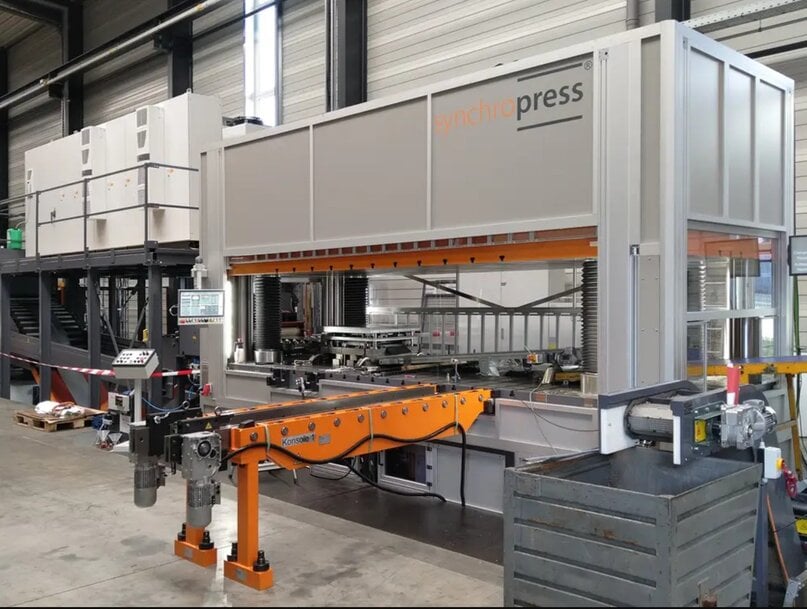
Industrial metal forming processes require precise control over ram kinematics, high force density, and extreme repeatability while operating under tightening grid constraints and volatile energy costs. In traditional mechanical and hydraulic presses, continuous idling, unbuffered peak power demands, and uncontrolled kinetic deceleration create high electrical installation costs and substantial energy losses. Drive system manufacturer Baumüller addresses these operational challenges through customized electric servo drives and hybrid servo-hydraulic architectures designed for screw presses and hydraulic forming machinery across the automotive, aerospace, and general metal fabrication industries.
Engineering Challenges in Heavy Metal Forming
The selection of a press drive architecture depends fundamentally on the targeted workpiece geometry, process velocity, and forming force profile. Screw presses and hydraulic presses present distinct physical challenges to drive engineers. Mechanical screw presses require rapid motor synchronization across multiple load axes to maintain parallel ram travel under off-center loading, alongside mechanisms to manage massive kinetic energy swings during reversing strokes. Hydraulic presses, conversely, often suffer from continuous motor operation during non-forming phases such as clamping dwell, part transfer, and tool positioning, resulting in parasitic power consumption and excess fluid heating.
Shared DC Link Architecture for Screw Presses
To address these parameters in screw press machinery, synchropress collaborated with Baumüller to engineer an intelligent drive system deployed across machines spanning pressing forces from 100 kN to 10,000 kN. The drive architecture in the synchropress 4M system replaces conventional overhead drive configurations with four threaded spindles driven by axially mounted motors positioned directly in the press table in line with the spindle mounts. Depending on the force rating, the machine utilizes either Baumüller DSD2 dynamic servo motors or high-torque DST2 motors. This axial arrangement eliminates auxiliary gear stages and reduces overall machine floor space requirements.
Synchronization across the four independent axes is managed by Baumüller b maXX 5100 active mains rectifier units linked to b maXX 5500 axis controllers. The core engineering mechanism relies on a shared direct current (DC) link connecting the regenerative rectifiers with b maXX 5300 or b maXX 5500 inverter units. Integrated capacitor banks within the common DC bus buffer cyclical power spikes that occur when the ram contacts the workpiece. As a result, the connected electrical line rating of the facility can be dimensioned for average rather than peak power demand, lowering electrical infrastructure expenditure.
Furthermore, the DC link recovers kinetic energy generated during ram deceleration. Following the forming stroke, kinetic braking energy is converted into electrical energy, buffered directly within the DC capacitor storage, and returned to the drive bus to power the subsequent working cycle. This closed energetic loop directly lowers overall kilowatt-hour consumption per formed part.
Demand-Responsive Servo Hydraulics for High-Force Forming
For hydraulic forming applications, Turkish press manufacturer Hürsan Pres integrated Baumüller drive technology into its SERVO press series, which launched in late 2024. The operational objective was to modernize the hydraulic pressure delivery while keeping established plant supervisory control systems intact.
The implemented servo-hydraulic system combines Baumüller DSD2 dynamic servo motors, b maXX 5500 servo converters, and integrated servo-hydraulic software modules running directly on the drive microprocessor. The system operates via a fixed displacement hydraulic pump coupled directly to the servo motor shaft. Fluid pressure and volume flow are controlled purely by dynamically modulating the rotational speed of the motor.
Unlike conventional induction-motor hydraulic power units that run continuously at fixed speeds against proportional bypass valves, the servo pump delivers volumetric flow strictly on demand. During non-productive stages of the cycle, such as pressure holding dwells, part loading, and dwell intervals, the servo motor reduces speed or stops entirely. This operational principle eliminates throttling losses across bypass valves, reduces thermal stress on hydraulic oil, and decreases overall cycle times through faster pressure rise dynamics.
"The machines needed to control the forming process precisely and deliver maximum forming force while keeping energy consumption as low as possible," states Alfons Knust, sales representative at Baumüller, regarding the design criteria for multi-axis forming equipment.
Additional Context
This section details technical specifications and competitive benchmarking not included in the original product announcement.
Industrial press manufacturers are increasingly replacing traditional flywheel clutches and asynchronous valve-throttled power units with servo-electric systems to comply with energy efficiency benchmarks such as ISO 50001 and regional industrial decarbonization initiatives. In screw press applications, conventional mechanical clutch drives exhibit cycle-to-cycle force variations up to 5 percent due to friction clutch wear and thermal expansion. Direct multi-spindle electric synchronization typically limits ram tilt to micro-radian tolerances, extending die life in precision forging and coin stamping operations.
Compared to standard constant-speed hydraulic systems with proportional valve throttling—which routinely exhibit energy efficiencies below 40 percent due to continuous oil circulation and heat dissipation—servo-pump systems operate at hydraulic efficiencies exceeding 70 to 80 percent. Common DC link architectures with capacitive or kinetic buffering represent an industry standard strategy for smoothing peak grid demands in cyclical machinery, often reducing facility transformer sizing requirements by 30 to 50 percent compared to unbuffered, direct-on-line drive designs.
Edited by Evgeny Churilov, Induportals Media - Adapted by AI.
www.baumueller.com
