
www.automation-mag.com
20
'26
Written on Modified on
Industrial Automation Safety And Machine Vision Integration
SICK presents adaptive optical protection systems and IIoT sensor platforms at SPS 2026 to resolve material handling bottlenecks and safety compliance.
www.sick.com
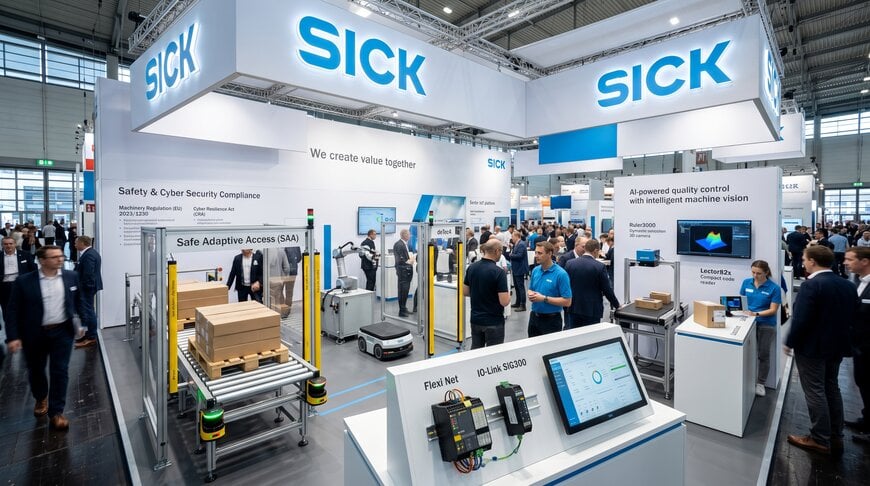
At Smart Production Solutions (SPS) 2026, held November 24–26, 2026, in Nuremberg, SICK demonstrates advanced safety technology, 3D machine vision, and digital infrastructure designed for discrete manufacturing, logistics, and process automation. The presented systems address access protection, quality inspection, and sensor data integration across industrial production lines.
Core Technology and System Architecture
The Safe Adaptive Access (SAA) system operates as an electro-sensitive protective device for material flow points. Consisting of two microScan3 safety laser scanners, a SIM1200 interface, and a FlexiNet controller, the system complies with Type 4, SIL 3, and PL d standards per EN ISO 415-8. It distinguishes personnel from transported goods through dynamic, automatic protective-field adjustment based on the geometry of conveyed objects, eliminating external muting sensors.
For safety light curtains, the DCM4 extension module enhances deTec4 units using Object Pattern Recognition (OPR). This software function continuously differentiates between human entry and defined material silhouettes during continuous material transfer, maintaining active safeguarding without physical muting barriers.
Control architecture is handled by the Flexi Net safety controller, certified up to PL e. The unit supports CPU expansion with up to twelve I/O and gateway modules, networking discrete machines across production lines with a configuration capacity of 512 TÜV-certified logic blocks. Integrated HTL inputs and dedicated Safe Motion function blocks support mobile robotics and automated guided vehicles.
Deployment and Implementation
The hardware integrates directly into automated manufacturing plants via standardized fieldbus protocols and IO-Link interfaces. Machine-level safety logic is engineered using validated software blocks, while the Sentio IIoT platform provides device management and interoperability with existing operational technology. Gateways such as the SIG300 connect sensor arrays to higher-level industrial automation networks, enabling multi-stage deployment without replacing legacy control systems.
Industry Applications
Target sectors encompass intralogistics, packaging, automotive manufacturing, and robotics. In automated material handling, dynamic protective fields allow continuous pallet transit while preventing human access to hazardous zones. In high-speed assembly lines, the compact Lector82x image-based code reader performs automatic identification in tight installation spaces with large depth-of-field tolerances. For non-contact quality assurance, SICK Nova 3D evaluates spatial metrics including volume, shape, and surface structure across 3D vision and LiDAR sensors such as the Ruler3000 and LMS4000 without manual code scripting.
Operational Impact and Performance Metrics
The systems improve process stability by removing false trips caused by payload variations on conveyor systems. SICK addresses upcoming regulatory requirements, including Machinery Regulation (EU) 2023/1230 taking effect in January 2027 and the Cyber Resilience Act (CRA) taking effect in December 2027. Both standards require hardware and software resilience against corruption.
Regarding engineering lifecycle management, Tobias Güttler, Vice President of Product Management at SICK Vertriebs-GmbH, stated: "Whether it’s a single sensor application or a high-performance system solution—we support our customers throughout the entire engineering process and lifecycle of our solutions. In doing so, we work with them to address the current challenges posed by the Machinery Regulation and the Cyber Resilience Act right from the start."
Edited by Evgeny Churilov, Induportals Media - Adapted by AI.
www.sick.com
