
www.automation-mag.com
30
'26
Written on Modified on
High-Performance 10GigE Vision Systems for Industrial Automation
Basler Releases Compact 10GigE Vision System with RDMA Support.
www.baslerweb.com
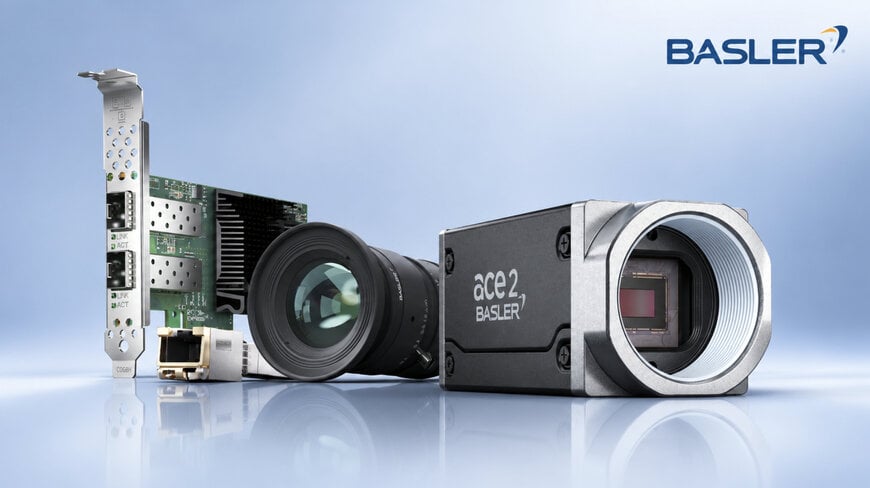
Basler introduced a high-performance, compact, and scalable 10GigE vision system designed for data-intensive machine vision applications, featuring stable data transmission, reduced host processor load, and low power consumption. The integrated hardware and software architecture aims to reduce system complexity, integration effort, and operating costs in industrial environments.
The technology combines compact, RDMA-capable ace 2 10GigE cameras, dedicated 10GigE network interface cards equipped with RDMA, the pylon software suite with GigE Vision 3.0 support, and matched accessories. The system reliably transmits the full 10 Gbps data rate from industrial cameras directly to the host PC. Multi-camera configurations and applications in quality inspection, robot guidance, logistics, wafer inspection, and semiconductor manufacturing benefit from high bandwidth, reduced CPU overhead, and long-term scalability. Furthermore, the Remote Direct Memory Access streaming protocol ensures minimal latency between image acquisition and downstream processing.
Hardware Architecture and Optical Performance
The ace 2 10GigE cameras utilize RJ45 connectors and support Power over Ethernet within a 29 mm by 29 mm by 61.5 mm physical footprint. This form factor facilitates mechanical integration in space-constrained machine layouts. The cameras incorporate Sony Pregius S sensors supporting both visible and ultraviolet spectra, yielding resolutions up to 24.4 megapixels and frame rates reaching 232 frames per second. Power consumption remains below 7 watts, minimizing thermal dissipation and operating expenses.
Basler’s proprietary 10GigE network interface cards feature RDMA support to optimize data throughput while minimizing CPU utilization. The variants with RJ45 ports support PoE for simultaneous data and power transmission over a single cable. An alternative variant utilizes an SFP+ interface for professional network installations requiring extended cabling or specific transceiver configurations. The broader component ecosystem includes compatible fixed focal length lenses, telecentric optics for various sensor dimensions, and specialized machine lighting modules.
Patrick Markiefka, Product Manager at Basler AG, stated that the matched component ecosystem provides a scalable foundation for multi-camera deployments and future-proof machine vision applications while lowering total cost of ownership.
Additional Context:
This section details technical specifications and competitive benchmarking not included in the original product announcement.
The 10GigE vision ecosystem relies on the GigE Vision 3.0 standard, which integrates RDMA over Converged Ethernet (RoCE) to bypass the host operating system's network stack. By transferring image packets directly into application memory via RDMA, CPU utilization drops significantly compared to standard GigE Vision implementations using standard socket layers, enabling sustained multi-camera data streaming at full line rates without packet loss.
In competitive benchmarking against standard 1GE (Gigabit Ethernet) and traditional USB3 Vision architectures, 10GigE vision systems with RDMA provide a tenfold increase in theoretical bandwidth compared to standard GigE, while eliminating the strict cable length limitations inherent to USB3. When compared against Camera Link HS or CoXPress alternatives, the 10GigE approach utilizes standard off-the-shelf Ethernet cabling infrastructure and network interface hardware, reducing overall system deployment expenses while maintaining deterministic latency below millisecond thresholds for industrial automation tasks.
Edited by Sucithra Mani, Induportals editor – adapted by AI.
www.baslerweb.com
