

www.automation-mag.com
05
'26
Written on
Modified on
Xaar News
Xaar to showcase advanced waveform technologies and robotic inkjet at IPI 2026
The company will highlight cross-industry collaborations in automotive painting and the critical role of waveform libraries in functional fluid jetting.
www.xaar.com
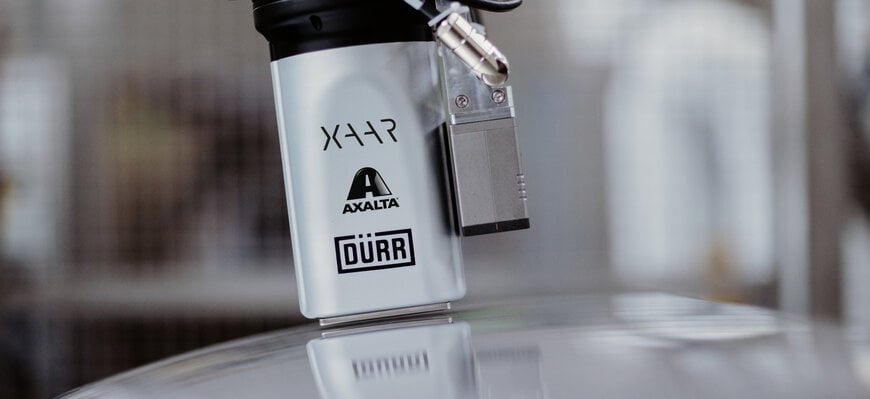
Xaar is set to demonstrate the expanding capabilities of industrial inkjet technology at the Industrial Print Integration (IPI) conference in Neuss, Germany, from November 24 to 25, 2026. The company will focus on how precise jetting expertise, tailored waveforms, and strategic partnerships are transforming inkjet from a traditional printing method into a highly reliable advanced manufacturing process for functional electronics, smart surfaces, and high-viscosity applications.
Robotic 3D painting and cross-industry collaboration
A major highlight of Xaar's participation is the keynote presentation on November 24, titled “The Future of Car Customisation: Digital Print Meets Robotic Precision.” Angus Condie of Xaar will co-present alongside Dr. Christian Engels of Axalta and Hans-Georg Fritz of Dürr Systems AG. The session will detail a groundbreaking collaborative project that integrates digital print technology, advanced automotive coatings, and robotics to automate the application of customized paint schemes across complex, three-dimensional vehicle surfaces. The presentation will underscore the technical challenges and market requirements of bringing digital paint personalization directly into OEM (Original Equipment Manufacturer) automotive production environments.
Waveform optimization for functional fluids
On November 25, Xaar’s Chief Technologist, Dr. Renzo Trip, will lead a technical session exploring the fundamental role of waveform development in functional printing. To accelerate the market readiness of novel inkjet applications, Xaar has introduced a comprehensive library of waveforms and fluid development services. By offering rheology measurement, materials compatibility testing, and advanced jetting diagnostics, the company enables manufacturers to precisely match complex customer fluids—ranging from standard inks to bespoke functional coatings—with optimized electrical waveforms. This ensures reliable, repeatable droplet formation in demanding, continuous industrial applications.
Additional Context: Piezoelectric waveforms and non-Newtonian fluid rheology
This section details the acoustic physics of Drop-on-Demand (DoD) printheads and fluid dynamics not included in the original press release.
In piezoelectric Drop-on-Demand (DoD) inkjet printing, a "waveform" is a precisely engineered electrical voltage pulse applied to the piezoelectric actuator (typically Lead Zirconate Titanate, or PZT) forming the walls or roof of the printhead ink chamber. This voltage profile causes the PZT crystal to deform in fractions of a microsecond, generating acoustic pressure waves that propagate through the fluid to eject a droplet from the nozzle. A standard waveform consists of a 'fill' phase (expanding the chamber to draw ink in), a 'fire' phase (contracting to push the fluid out), and a 'dampen' phase (canceling residual acoustic resonance to prevent the nozzle from weeping or ingesting air).
When printing functional fluids—such as the high-viscosity automotive clearcoats or conductive nanoparticle suspensions discussed at IPI—engineers face severe rheological challenges. These fluids often exhibit non-Newtonian, shear-thinning behavior and possess high particulate loadings. To successfully jet these dense suspensions without clogging the nozzle or generating unwanted "satellite" drops (tiny secondary droplets caused by the messy snapping of the fluid ligament), manufacturers must develop highly complex, multi-pulse waveforms. These bespoke electrical profiles manipulate the internal acoustic resonance to cleanly pinch off the heavy fluid ligament, ensuring precise volumetric control, optimal drop velocity, and absolute placement accuracy on 3D surfaces.
Edited by an industrial journalist, Lekshman Ramdas, with AI assistance.
www.xaar.com
